


Bankruptcy & Security Clearance Help



Accomplished Security Clearance Lawyers Since 1976
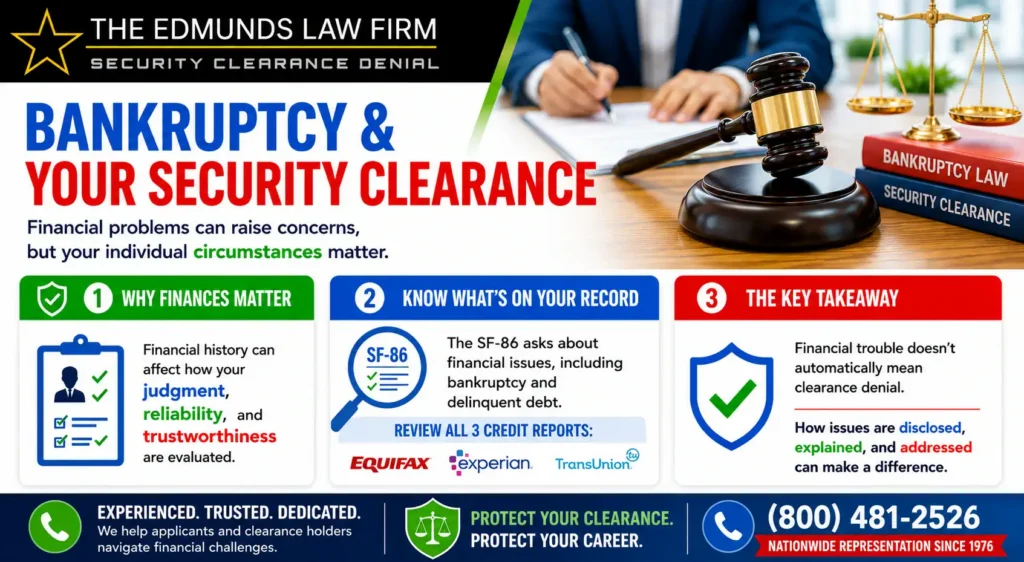
Standard Form 86 (SF-86), a Questionnaire for National Security Positions, will ask questions about your finances when you apply for a job requiring national security clearance. The questions in Sections 27 and 28 are in regards to your financial record and your financial delinquencies. The questions concern your past seven years and are not limited by your age.
To be prepared to answer questions on your application, it is imperative to obtain reports from all three of the nationwide consumer credit reporting agencies:
- Equifax
- Experian
- Transunion
Even if you believe you have completely satisfactory ratings, it is essential to know what is in all three of the reports before finishing this part of SF-86. You are entitled to a free report from all three agencies every 12 months. Our firm can answer your questions and help enhance and perfect your security clearance application. Call The Edmunds Law Firm to speak with a security clearance attorney.
Security Clearance Victory: Overcoming Financial Hardship & Government Scrutiny

Why Do My Finances Matter for a Security Clearance?
The reason for asking about your financial history is that irresponsibility in this area can be a sign of “poor self-control, lack of judgment, or unwillingness to abide by rules and regulations, all of which may reflect on a person’s reliability, trustworthiness, and ability to protect classified information,” the Applicable Adjudicative Guidelines state.
The guidelines continue, saying that someone who is in debt might have to resort to illegal means to obtain money. Compulsive gambling, for example, can lead to financial crimes that might include espionage. In addition, having a lot of money also raises suspicion if the sources of the income cannot be adequately explained.

Listing Bankruptcies
Sections 27 and 28 on your questionnaire are where you will have the opportunity to list and describe any bankruptcies you have had. It will be important to speak with a lawyer about the differences between a Chapter 7 and a Chapter 13 bankruptcy and how they relate to your application for a national security position.
The financial section of your application for national security clearance is complex. Understanding how to answer the questions and what information to include is important. If you have had problems with debts or bankruptcy, you should call The Edmunds Law Firm for help. Our firm is dedicated to serving people who are applying for national security and who have financial issues.
Learn How We Can Help When You Call Us for a Consultation
Our experienced security clearance lawyers can help guide you through the extremely complicated application process. We can also help you if you’ve been denied a security clearance based on your financial history.
To find out how we can help you, please contact us today at (800) 481-2526 to arrange a private consultation.
Debt Problems & Your Security Clearance

Financial problems are one of the most common areas of concern for people applying for or holding national security clearance. Issues like bankruptcy filings and delinquent debt can be a barrier to security clearance, or even put an existing clearance in jeopardy. However, in a security clearance investigation, financial struggles like bankruptcy or significant debt are assessed based on the specific circumstances of your case.
The best way to find out how your particular financial issues may be treated in a security clearance investigation or review is to talk to an attorney experienced with bankruptcy and security clearance. To give you a general overview of bankruptcy security clearance issues, we’re providing answers to some of the questions we hear most below.
Bankruptcy Security Clearance FAQs
You generally won’t automatically lose your security clearance if you file for bankruptcy, but the bankruptcy filing may trigger an investigation into whether your security clearance should be revoked.
At The Edmunds Law Firm, we have extensive experience helping people who have filed for bankruptcy or have other problems with debt preserve their security clearances. The sooner you consult a seasoned professional, the better. The way you handle your debt and your bankruptcy filing can impact whether the government sees you as a security risk.
If you’ve filed for bankruptcy with security clearance or are seeking security clearance after bankruptcy, the government will look at your actions and choices. For example, a bankruptcy triggered by huge medical bills may be viewed differently than a bankruptcy case filed to discharge high credit card balances from shopping sprees and leisure travel.
Similarly, the government will consider your efforts to resolve the debt responsibly, and whether the financial problems were short-term and tied to a one-off event or part of a long-term pattern of financial irresponsibility.
At The Edmunds Law Firm, we have decades of experience helping people with bankruptcies and other financial black marks secure or maintain their security clearance. Call us today to learn more about how we can help you.
While you won’t be asked to list every outstanding debt on your SF-86 form, a credit check is a standard part of the security clearance investigation. Your outstanding credit card debt and other obligations will be reviewed during your bankruptcy and security clearance investigation.
In addition, Section 26 of the SF-86 form requires you to disclose various types of delinquent debt across the preceding seven years. These include foreclosures, repossessions, debts turned over to collection agencies, debts 120 days or more in arrears, credit cards closed due to non-payment or delinquent payments, and more. Section 28 requires you to disclose any civil lawsuits, including debt collection cases.
Like other debt and bankruptcy-related issues, no particular credit card balance or delinquency is an automatic dealbreaker. Getting the right guidance on how to address delinquencies can make all the difference.
Credit card debt security clearance issues can be serious, but they can also be manageable. A key consideration is what steps you took to manage your debt responsibly. So, it’s in your best interest to get advice from an experienced national security clearance lawyer as soon as possible. Don’t wait until your debt reaches a crisis point or you receive a notification that your security clearance is being reviewed to get knowledgeable guidance about your situation and the possible impact on your security clearance.

Facing a Security Clearance Issue?
Free, confidential consultation with an attorney who does this every day. Nationwide representation, open 24/7.