
Department of Defense (DoD) Security Clearances
Top-Ranked Attorneys for DoD Security Clearance
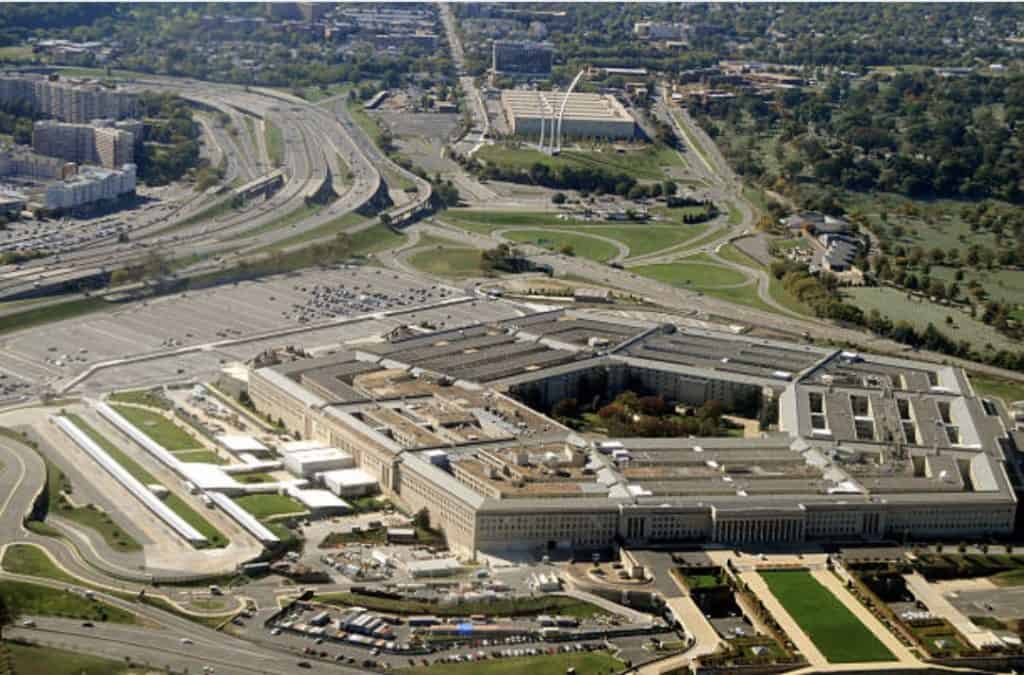 Department of Defense (DoD) security clearance problems are handled quite frequently at The Edmunds Law Firm. The DoD-which has headquarters in Alexandria, Virginia and field offices across the country-is the main source of security clearances in the United States. An agency within the DoD, the Defense Security Service (DSS), provides security support services to federal defense agencies, the military, and over 20 other federal agencies. The DSS is responsible for processing DoD security clearances.
Three Decades of DoD Security Clearance Experience
Whether you are at the pre-application stage, the hearing stage, or want to appeal an adverse decision regarding a DoD security clearance, Attorney Alan V. Edmunds is prepared to maximize the chances of your success. He has over 40 years of experience in handling DoD security clearance issues and has a breadth of knowledge about this particular body of law. The Edmunds Law Firm assists individuals across the United States. In fact, Mr. Edmunds is among a small number of DoD security clearance lawyers who handle DoD security clearances at any location in the country.
The DoD Security Clearance Process
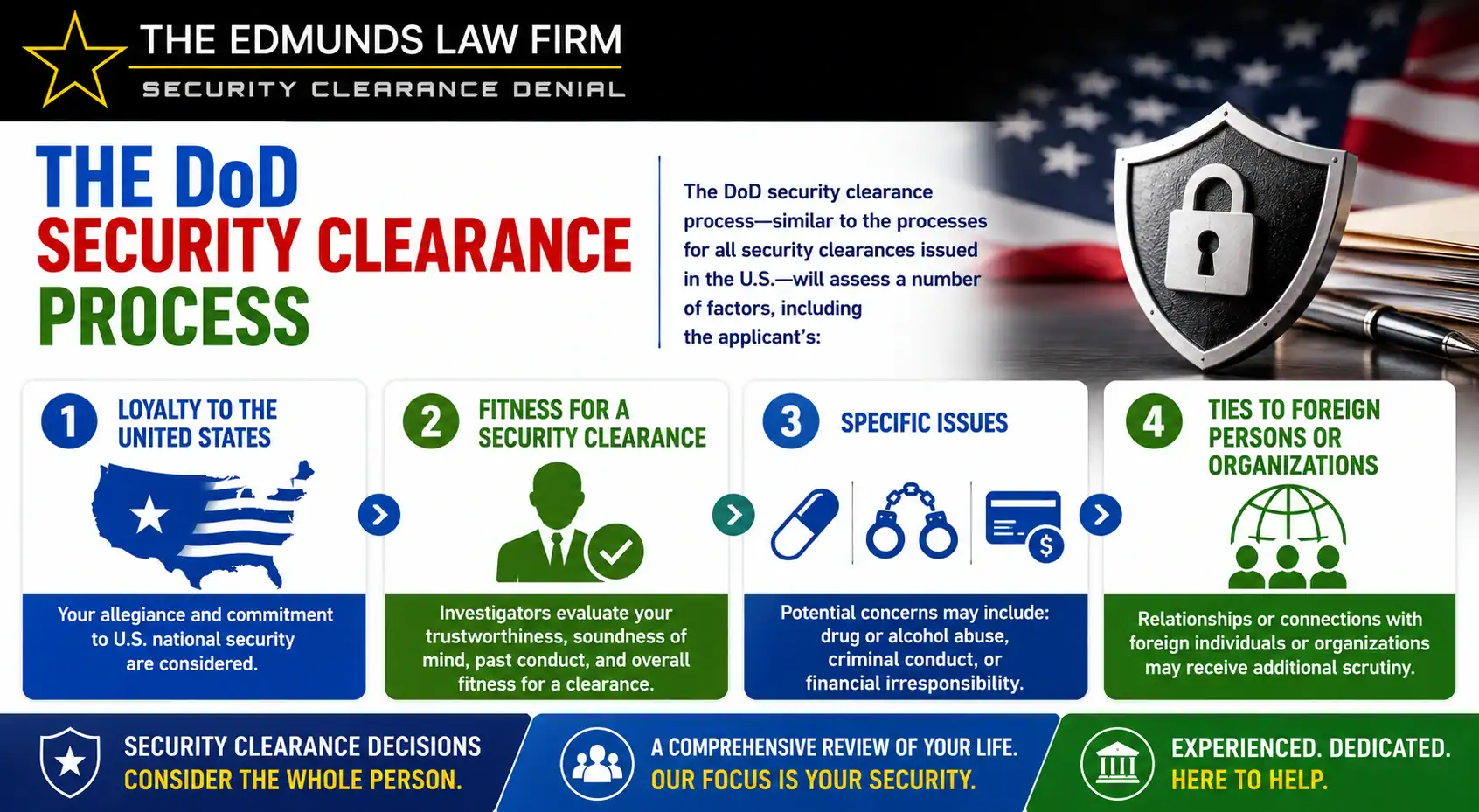
- The DoD security clearance process—similar to the processes for all security clearances issued in the U.S.—will assess a number of factors, including the applicant’s:
- Loyalty to the United States
- Fitness for a security clearance-his or her trustworthiness, soundness of mind, and past conduct
- Specific issues such as drug or alcohol abuse, criminal conduct, or financial irresponsibility
- Ties to persons or organizations of a foreign nature or of concern to the relevant U.S. agency
Denial or Revocation of a DoD Security Clearance
When a DoD security clearance is denied, or when the DoD security clearance that an individual already possessed is revoked, the person may receive a document called a “Statement of Reasons,” or a document called “Letter of Intent to Revoke” or “Decision to Revoke.”
- These documents may give details about the denial or revocation that concern one or more aspects of the individual’s past, including:
- Criminal history
- Drug and alcohol use
- Education
- Employment
- Family
- Financial and credit history
- Foreign influence and preference
- Personal conduct
- Psychological profile
- Residences
Call Our Attorney About Your DoD Security Clearance
If you are experiencing problems with your application for a DoD security clearance or if you are in danger of losing your clearance, contact the DoD security clearance attorneys at The Edmunds Law Firm to arrange a consultation with Attorney Alan V. Edmunds today. Your concerns regarding your DoD security clearance will be addressed in detail.
Call us at (800) 481-2526 to learn more!
DoD Security Clearance FAQs
Can you apply for a DoD security clearance on your own?
No, you cannot start the DoD security clearance process on your own. A sponsoring government agency, military branch, or cleared contractor must initiate the process before you can complete the required security clearance forms.
Once the process begins, you will typically be asked to complete an electronic questionnaire, often through the SF-86 process. This form asks for detailed information about your employment, residences, finances, criminal history, foreign contacts, drug or alcohol issues, mental health history, and other areas that may affect national security eligibility.
You are allowed to complete the questionnaire without legal help, but that can be risky if there are possible issues in your background. Small omissions, unclear answers, or inconsistent explanations can create problems later in the investigation. If you are applying for a security clearance for DoD and have concerns about debt, drug use, criminal history, foreign influence, past employment issues, or prior clearance problems, it is often best to speak with an experienced DoD security clearance lawyer before submitting your materials.
Do you need a lawyer for a DoD security clearance issue?
No, you are not required to hire a lawyer for a DoD security clearance issue, but the right legal guidance can make a major difference. A DoD security clearance lawyer can help you understand the process, prepare accurate responses, avoid damaging mistakes, and respond effectively if the government raises security concerns.
Many clearance problems begin because the applicant did not understand what the form, investigator, polygraph examiner, or adjudicator was really asking. Others arise because the applicant gave incomplete answers, failed to provide context, or waited too long to address obvious red flags.
Legal help becomes especially important if you receive a Statement of Reasons, notice of intent to deny or revoke clearance, request for additional information, or adverse decision. If you need to appeal a DoD security clearance denial, your response must be thorough, organized, and supported by the right evidence.
You can apply, respond, and appeal on your own, but experienced DoD security clearance appeal attorneys know how to present mitigation, address the adjudicative guidelines, and protect your career.
What can disqualify you from a DoD security clearance?
A DoD security clearance can be denied or revoked when the government believes there is a security concern that has not been properly mitigated. The decision is based on the whole-person concept, which means adjudicators look at both the concerning information and the evidence showing rehabilitation, reliability, honesty, or reduced risk.
The 13 adjudicative guideline areas include:
- Allegiance to the United States
- Foreign influence
- Foreign preference
- Sexual behavior
- Personal conduct
- Financial considerations
- Alcohol consumption
- Drug involvement and substance misuse
- Psychological conditions
- Criminal conduct
- Handling protected information
- Outside activities
- Use of information technology
Common issues include delinquent debt, tax problems, drug use, alcohol-related incidents, criminal charges, omitted information on the SF-86, foreign contacts, foreign assets, misuse of government systems, mishandling protected information, or concerns about judgment and honesty.
A red flag does not automatically mean you will be denied. Many concerns can be mitigated with evidence showing the issue was isolated, old, resolved, reported honestly, unlikely to recur, or outweighed by a strong record of responsibility. The best time to address these concerns is before the government reaches an adverse decision. If you already received a Statement of Reasons, a response to the Statement of Reasons may still help you protect your eligibility.
Can you appeal a denied DoD security clearance?
Yes, you can appeal a denied DoD security clearance. In many cases, you will first receive a Statement of Reasons explaining why the government intends to deny or revoke your clearance, and you will have an opportunity to respond before a final decision is made.
This stage is critical. A strong SOR response can sometimes resolve the government’s concerns before the case proceeds further. Your response should address each allegation directly, admit what is true, deny what is inaccurate, correct misleading details, and provide evidence showing mitigation.
If your clearance is denied or revoked after your response, you may still have appeal rights. Depending on your case, you may be able to request a hearing, submit a written appeal, or present additional information through the appropriate process.
It is best to speak with a lawyer as soon as you receive an SOR, notice of intent to deny, notice of intent to revoke, or final denial letter. The deadlines are short, and the choices you make early can affect whether you receive a hearing, what evidence is considered, and how strong your appeal will be.
How long do you have to respond to a DoD security clearance denial or revocation?
Your deadline depends on the notice you received, so you should read the letter carefully and act immediately. In many DoD industrial security clearance cases, a response to a Statement of Reasons must often be received within 20 days of receipt, though an extension may be available for good cause.
A proper SOR response is not a short explanation. It should respond to each allegation, provide context, include supporting documents, and show why granting or continuing clearance is clearly consistent with the interests of national security.
If your clearance has already been denied or revoked, your appeal deadline may be different. Some notices may require quick action to preserve your right to appeal, request a hearing, or submit supporting materials. Do not assume you have extra time.
If you receive any adverse DoD security clearance notice, contact an experienced security clearance lawyer right away. Waiting even a few days can make it harder to gather records, prepare declarations, request documents, and build a complete response.
What are the requirements for a DoD security clearance?
DoD security clearance requirements focus on whether granting or continuing access to classified information is clearly consistent with national security. The process usually includes sponsorship, completion of the required security questionnaire, fingerprinting, a background investigation, adjudication, and, for some positions, a polygraph or additional review.
The level of investigation depends on the position, the type of access required, and the potential harm that could result from misuse of classified information. A secret clearance for DoD generally requires less extensive investigation than a top secret or SCI-related position, but both still require honesty, reliability, trustworthiness, and sound judgment.
Adjudicators review both negative and positive information. For example, financial problems may raise concern, but proof of repayment plans, counseling, stable income, tax compliance, or responsible behavior can help mitigate the issue. The same type of analysis applies to many clearance concerns, including drug use, alcohol use, criminal conduct, foreign influence, and personal conduct.
The goal is not to prove you have lived a perfect life. The goal is to show that any security concerns have been addressed and that you can be trusted with classified information.
What should you do if you receive a Statement of Reasons for a DoD clearance?
If you receive a Statement of Reasons, you should read it immediately, identify your response deadline, and begin gathering evidence. An SOR means the government has identified specific concerns that may lead to denial or revocation of your clearance unless you respond effectively.
Do not send a rushed response, emotional explanation, or general denial. In DoD industrial security clearance cases, the answer typically must admit or deny each allegation. A vague denial or incomplete answer can damage your case.
A strong response may include financial records, proof of payments, tax documents, counseling records, treatment records, court documents, character letters, employment history, performance reviews, military records, declarations, and other evidence tied directly to the allegations.
The Edmunds Law Firm helps applicants and clearance holders prepare detailed SOR responses, appeal adverse decisions, and address the specific issues that may threaten their DoD clearance. If you received an SOR or denial notice, contact the firm before your deadline passes.
Security Clearance Guidelines

What You Need to Know About Security Clearance Guideline I
The U.S. Department of State determines the people that receive security clearance based on very specific guidelines. Their decision takes into account potential conflicts of interest, reliability, trustworthiness, self-discipline, integrity, and ability to protect classified

What You Need to Know About Guideline H: Your Security Clearance & Drug Use
In the last entry of multipart blog series, we discussed how Security Guideline G will stop you from getting security clearance due to excessive alcohol consumption and the lack of better judgement it causes.

What You Need to Know About Guideline G: Security Clearance & Your Alcohol Use
As intrusive as it may seem, the United States government is going to pry into your private and social life before giving you security clearance. Everything from with whom you used to associate right

What You Need to Know About Guideline F: Security Clearance & Financial Issues
What is Guideline F: Financial Considerations and How Does it Affect Your Security Clearance? Many Security Clearance Guidelines judge a person’s character, and therefore their ability to gain clearance or not, using traits that people

What You Need to Know About Security Clearance Guideline E
Your own personal conduct can be a true reflection of who you really are, and the United States government and its agencies know this. If you have conducted yourself in questionable or unfavorable ways in

What You Need to Know About Security Clearance Guideline D
According to the United States government and its numerous agencies, an individual’s sexual behavior can indicate underlying personality disorders, mental instability, or emotional trauma. In some cases, it is believed that a person’s sexual
What You Need to Know About Security Clearance Guideline C
The topic of national security clearance is taken gravely each time it comes into question here in the United States. The government and its many agencies has its reasons for keeping certain information away
What You Need to Know About Security Clearance Guideline B
National security clearance is only granted to individuals who the United States government knows it can trust beyond any doubt. To establish this trust and the necessity for clearance, an applicant must meet a
What You Need to Know About Security Clearance Guideline A
When a member of the government or an interested private party seeks national security clearance, whether they be a military officer or a Secret Service agent, they must meet several guidelines before they can be