


Security Clearance Formal Hearing Help



Nationally-Ranked Security Clearance Attorneys with a Winning Track Record
The Edmunds Law Firm has excelled over the years in helping people obtain national security clearances and in overturning denials of security clearance applications. The firm has been in business for more than 40 years, and security clearance issues constitute a major part of our business. We can assist you and represent you in a formal hearing.
Government Leans Towards Denial
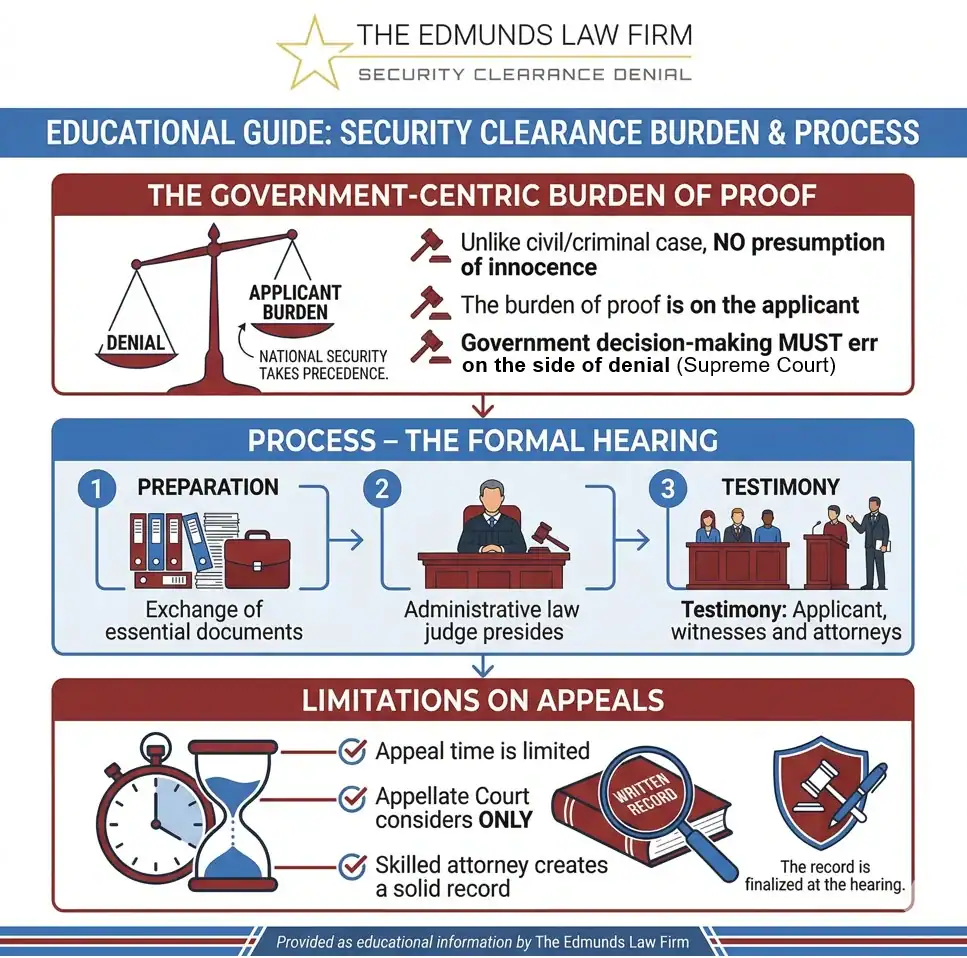
When someone applies for a national security clearance, the decision to approve the application or to approve the applicant’s appeal for the reversal of a negative decision is “government-centric.” That is, unlike civil or criminal proceedings, the defendant, or in this situation the applicant, does not have the “presumption of innocence.” The burden of proof is not on the government, it is on the applicant.
The applicant must prove that he or she is suitable for receiving a national security clearance. By a Supreme Court decision, the determination of whether to confer a security clearance must err on the side of denial in all stages of the decision-making process. This means that if there is a question, the government will fault toward denial.
The Formal Hearing
This approach to err on the side of the government versus that of the applicant applies during the formal hearing as it does in other parts of the application process. An administrative law judge presides over the formal hearing. It is imperative to have the representation of a skilled national security lawyer for your formal hearing. The applicant, possibly other witnesses, or your attorney will testify at the hearing. Many documents will be exchanged to prepare for the hearing, and having the representation of a seasoned national security attorney to prepare these documents is essential.
The judge determines whether to confer national security clearance. The applicant has a limited amount of time in which to appeal a negative decision. However, in considering the appeal, the court will only base its decision on the written record that is presented at the hearing. This is why having a skilled, experienced security clearance attorney who has represented many clients in similar previous cases is so essential.
Contact The Edmunds Law Firm for a Consultation
The Edmunds Law Firm has been successfully helping applicants gain national security clearance or overturn denials of clearance for years. The firm was established more than 40 years ago and has established a solid reputation for success.
To improve your chances of having your security clearance approved, contact The Edmunds Law Firm at (800) 481-2526.
Frequently Asked Questions about Security Clearance Formal Hearings
The best way to prepare for a security clearance hearing is to understand the government’s concerns, review the evidence against you, and build a clear response supported by documentation and testimony. A hearing is not something you should walk into casually, especially when your clearance, career, and reputation may be at stake.
The government may provide a large set of documents before the hearing. These records can feel overwhelming, but each document matters. You need to understand what the government is relying on, what the evidence is meant to prove, and how to rebut or mitigate the concerns raised.
You should also understand the hearing process itself. In many cases, you will be presenting your case against a government attorney. A federal security clearance attorney can review the government’s documents, identify what evidence is needed, prepare exhibits, help you prepare to testify, and present your case effectively.
Attorney Alan Edmunds has personally handled more than 3,000 security clearance hearings and is prepared to fight for you at every step in the process.
A security clearance hearing may last a few hours, half a day, or longer depending on the number of issues involved and the complexity of the evidence. Some hearings are relatively short when the concerns are limited and straightforward. More complex cases may require a full day or even multiple days.
The length of your hearing may depend on several factors, including:
- The number of security concerns listed
- The amount of documentary evidence involved
- Whether witnesses will testify
- Whether the government presents witnesses
- The complexity of the mitigating evidence
When you speak with an experienced attorney about appealing a security clearance denial, your lawyer should be able to give you a better idea of what to expect based on the facts of your case. Your attorney can also explain the hearing procedures, help you prepare to testify, and handle the presentation of evidence and witness questioning.
In many cases, requesting a security clearance hearing is the better option, but not every case is the same. A hearing may give you the opportunity to testify, present witnesses, answer concerns directly, and allow the decision-maker to assess your credibility in person.
A written record decision may be appropriate in some limited situations, especially when the issues are narrow and the supporting evidence is strong. But choosing the written record alone can be risky because you may lose the chance to explain your situation in person or respond to questions.
It is also important to understand that requesting a hearing does not always mean the hearing will happen. If you submit a strong written response to a Statement of Reasons and support it with persuasive evidence, the government may withdraw the Statement of Reasons before the hearing takes place.
An experienced federal security clearance attorney can help you decide whether a hearing or written record decision gives you the best chance of success.
The main advantage of a security clearance hearing is that it gives you the opportunity to present your case in person. The decision-maker can hear directly from you, evaluate your credibility, and consider your explanation along with the evidence and legal arguments.
A hearing may also allow you to:
- Testify about the facts and mitigating circumstances
- Present witnesses who can support your case
- Submit exhibits and supporting documents
- Respond directly to the government’s concerns
- Cross-examine government witnesses when applicable
The disadvantage is that a security clearance hearing is formal, stressful, and difficult to handle without legal experience. You may be expected to understand how to introduce evidence, question witnesses, respond to objections, and make arguments that address the relevant security clearance guidelines.
A personal appearance may be somewhat less formal than a hearing, but it can still be risky to handle alone. If your career depends on the outcome, working with the best security clearance lawyer for your case can help you avoid mistakes and present the strongest possible response.
No, you do not automatically get a security clearance hearing in every case. Whether a hearing is available depends on the type of case, the agency involved, and the stage of the process.
In many cases, you may have to request a hearing by the deadline provided in your notice. In other cases, the process may involve a written response, written appeal, personal appearance, or another form of review. The procedure can also differ depending on whether you are a contractor, federal employee, military member, or applicant.
If you received a Statement of Reasons or notice of denial, do not assume the next step is automatic. Speak with an experienced security clearance lawyer as soon as possible so you understand your options, deadlines, and whether requesting a hearing is the right move for your case.

Facing a Security Clearance Issue?
Free, confidential consultation with an attorney who does this every day. Nationwide representation, open 24/7.