
Act Fast: Why You Need a Security Clearance Revocation Lawyer Immediately
Your Top Choice For Security Clearance 
Security clearance revocation can threaten your role, your income, your reputation, and even your future opportunities. Fortunately, you can fight revocation of security clearance. Unfortunately, many people facing revocation don’t know how to fight it, or wait too long to address the problems.
At The Edmunds Law Firm, we have extensive experience helping government employees, contractors, and members of the military fight security clearance revocation for decades. With the right preparation and documentation, many people can overcome efforts to revoke their security clearance, but it’s important to act quickly and to have complete information about what’s required.
Common Reasons for Security Clearance Revocation
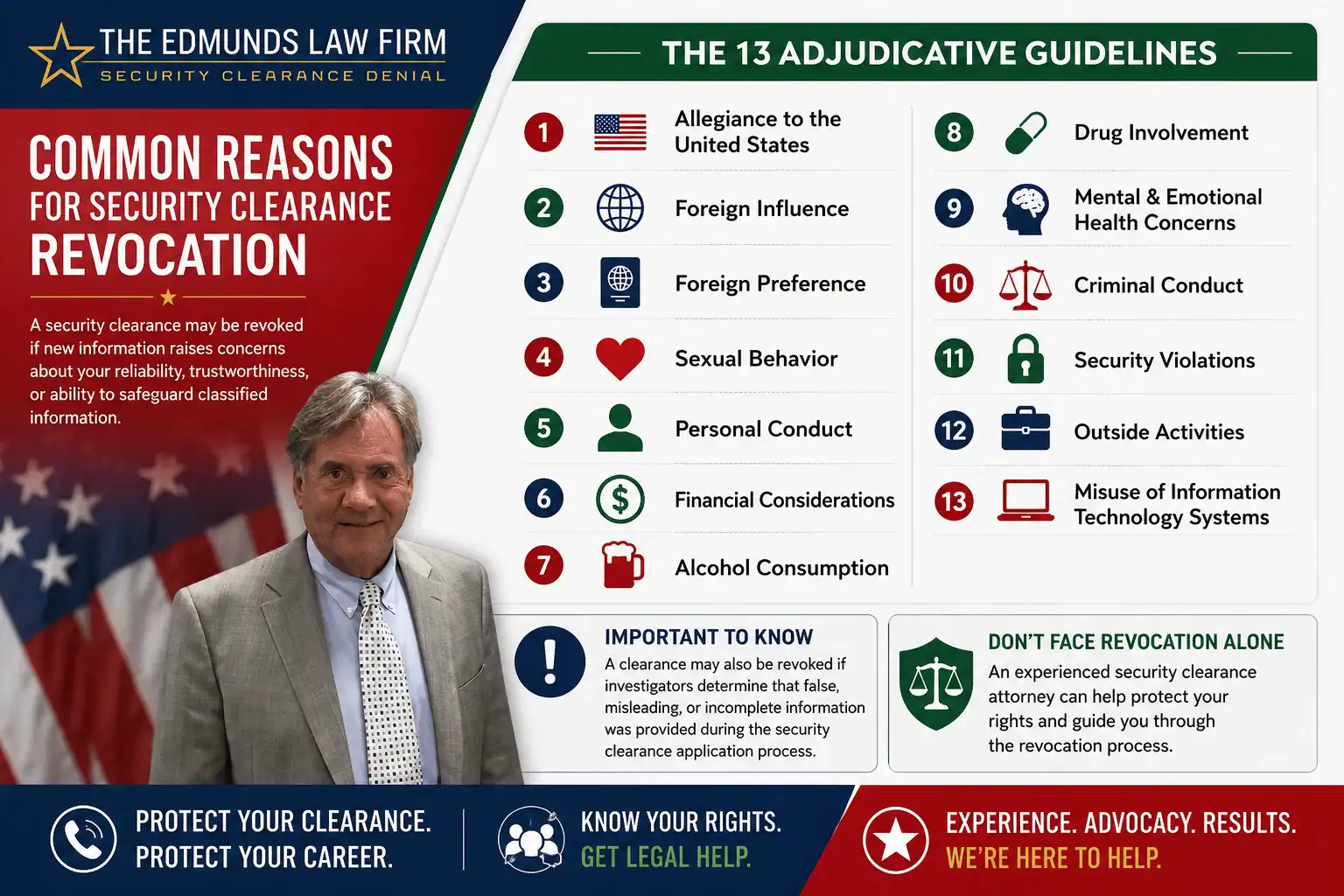
Security clearance can be revoked based on any information that suggests that you may be a threat to national security. Most often, those reasons fall under one of the same 13 guidelines considered when you apply for security clearance. They are:
- Allegiance to the United States
- Foreign Influence
- Foreign Preference
- Sexual Behavior
- Personal Conduct
- Financial Considerations
- Alcohol Consumption
- Drug Involvement
- Emotional, Mental, and Personality Disorders
- Criminal Conduct
- Security Violations
- Outside Activities
- Misuse of Information Technology Systems
As you can see, the possible reasons for revoking security clearance are quite broad. You could also face revocation if the government later discovered that you had not been entirely honest in the application process.
Security Clearance Revoked or Denied? We Can Help!
What To Do If You’re Facing Revocation of Security Clearance
You should contact a security clearance revocation attorney immediately when you believe your security clearance is at risk. In some cases, you won’t know that your clearance is in danger until you receive a notice. In other situations, you may see the issue coming before the process starts moving forward.
One way that might happen is that something occurs that you know may jeopardize your clearance, even though the government hasn’t reached out to you and may not even know about it yet. For example, you might have been accused of a crime, or you may know that you have a growing pile of delinquent debt that will soon lead to lawsuits or bankruptcy.
If you see a possible threat to your security clearance coming, you should not wait until you receive a notice to seek legal assistance.
First Steps When You Receive a Notice of Intent to Revoke Security Clearance
The security clearance revocation process is described in greater detail below, but there are a few things you need to know and act on right away.
- The clock starts ticking when you are served a Notice of Intent, and your time to respond is typically very limited
- You should read the notice and all accompanying documents carefully as soon as you receive them to make sure you know what to do and don’t miss any deadlines
- Preparing a response will almost certainly take longer than you think–an effective response is usually 20 pages or longer and often includes supporting documentation you may need to gather from outside sources
- You’ll want to contact an experienced security clearance revocation attorney immediately to ensure that your lawyer has sufficient time to gather evidence and respond in depth
Common Mistakes When Your Security Clearance is at Risk
If you’re facing security clearance revocation and your job or pending offer is on the line, you’ll have to act quickly and carefully to try to save your clearance. An experienced security clearance attorney can help you avoid common mistakes such as:
- Missing the deadline to respond to the Statement of Reasons (SOR)
- Waiting too long to start preparing your response and not having time to do a thorough job
- Justifying and minimizing instead of mitigating
- Failing to provide adequate documentation to support mitigating factors
- Responding in a narrative that is too long and/or fails to stay focused on the point of mitigation
- Providing responses that are too cursory or not responding to every point raised
- Making inconsistent or emotionally-driven arguments
Often, these and other errors all stem from the same initial mistake: the decision to attempt to respond on your own rather than immediately consulting a security clearance attorney. Sometimes, those mistakes continue to haunt you, even if you get experienced legal representation later.
For example, you could create long-term credibility issues if:
- Your response contains a material error
- Your response contains a half-truth or seems to try to obfuscate an issue or conceal something unfavorable
- Your response is defensive or minimizes the seriousness of the allegations against you
- You overshare, overexplain or respond emotionally rather than tactically
Repairing the damage is sometimes possible, but it is nearly always more difficult and less certain than providing an effective, well-crafted, well-supported response the first time.
There’s no reason to go it alone. Our security clearance revocation lawyers have the knowledge and experience to draft the most effective response possible, and to represent you at a hearing if necessary. Call us today at (800) 481-2526 or fill out our contact form to learn more.
How Our Security Clearance Lawyers Can Make a Difference
It’s easy to talk generally about how the right security clearance lawyer can improve your chances of success when your clearance is at risk. At The Edmunds Law Firm, we don’t have to explain in hypotheticals or generalities–we have thousands of real cases to share. You can learn more about some of our successes and see what past clients have to say.
Here are some examples of the difference the right security clearance attorney can make.
Favorable Results in Security Clearance Revocation Cases
Case 1: Avoiding a Hearing with Strong Written Responses
In this case, our client had an in-person appearance scheduled. As it often does, the government served the client with interrogatories, formally known as Supplemental Information Requests (SIR). These are questions the person fighting for their security clearance must answer under oath.
The client brought the SIR to The Edmunds Law Firm and we prepared responses on his behalf.
In addition to responding to the questions asked, we attached evidence supporting our responses and presented a legal argument explaining why our client did not present a security risk under the adjudicative guidelines. Soon after, our client received a notice that their personal appearance had been canceled because the written responses we submitted were sufficient to support a decision in our client’s favor without the need for him to appear.
Too often, people who try to fight security clearance revocation on their own miss this sort of opportunity simply because the don’t know what type of information and evidence the government is looking for, don’t know how to obtain the necessary evidence, or don’t have the knowledge to provide a legal argument based on that information and documentation. This early win without a hearing demonstrates just how important it is to have an informed strategist on your side.
Case 2: Restoring Security Clearance after Findings of Marijuana Use
Our client was appealing security clearance revocation based on marijuana use. The government’s two allegations were:
- Marijuana use with varying frequency between 2018 and 2024, and
- Testing positive for marijuana in February of 2024
Marijuana cases are more challenging than many people expect. Marijuana has been legalized in many U.S. states, and in 2022 former President Biden pardoned thousands of people with federal or D.C. marijuana-related criminal convictions. That leads many people to believe it won’t be a serious issue in the security clearance process. That’s generally not true–at least, not yet.
We took the findings seriously and prepared a thorough case, which included 25 documents introduced into evidence and the testimony of our client. The judge found that our client’s security clearance should be restored.
How the Security Clearance Revocation Process Works
Statement of Reasons
The process of revoking security clearance begins with a notice called a Statement of Reasons (SOR). The SOR contains a list of reasons the government is considering revoking your security clearance. When you receive this notice, your security clearance has not yet been revoked. However, in some serious situations, security clearance may be suspended.
You will have an opportunity to respond to the SOR, but your time to do so is typically very limited. An effective response to an SOR is thorough and detailed, often running to 20 pages or more. So, you should contact a security clearance revocation attorney immediately when you receive an SOR.
How to Respond to a Statement of Reasons (SOR)
When you receive a Statement of Reasons, immediately check the deadline for your response. You likely won’t have long to respond, and drafting a thorough response is a big job. You will need to respond to the listed reasons point by point, and to be clear and detailed in your response.
Your attorney can work with you to determine what information and documentation you should include in your response and can draft responses for you. Depending on the circumstances, your responses may correct errors in the allegations and provide documentation, or may offer mitigating factors. For example, if the issue is financial, you may explain a short-term situation that led to the problems and the steps you have taken to get back on track.
Security Clearance Revocation Hearings: What to Expect
When you receive your SOR, you will also get information about your rights. Often, you will have the right to request a hearing. Usually, it is in your best interest to request a hearing if you have the option. Your attorney can assess your situation and advise you on whether or not you should request a hearing.
The process differs somewhat depending on the department or agency involved. In most cases, the hearing will be through the Defense Office of Hearings and Appeals (DOHA). If you’ve requested a hearing and you haven’t already hired an attorney, you should do so right away. It can be difficult to successfully navigate the hearing on your own, but an experienced security clearance revocation lawyer can tell you what to expect, help you prepare, and represent you at the hearing.
Even if you’ve been all the way through this process and lost, you may have options. To learn more, call (800) 481-2526 or fill out our contact form.
Can You Reapply After a Security Clearance Revocation?
If you lose your appeal and the revocation of your security clearance becomes final, you can reapply for security clearance, but the process is neither quick nor easy. First, you will generally have to wait 12 months after the final determination to reapply. And, just like when you initially applied for security clearance, you’ll need a sponsoring agency or department to initiate the application process.
You should also be prepared to show evidence of mitigation of whatever actions or circumstances triggered the revocation of your clearance. If you’re considering reapplying for clearance after a revocation, you should consult an experienced national security clearance lawyer before you get started to learn more about what type of evidence you will need to overcome the prior revocation.
Why Clients Trust Our Security Clearance Revocation Lawyers
Attorney Alan Edmunds and his team of security clearance lawyers have extensive experience with all phases of the national security clearance process, from the initial application to appealing clearance denials or revocations. We have in-depth knowledge of security clearance law and procedures, and we know what type of evidence and arguments tend to be effective in the face of specific types of allegations. We also understand how important security clearance can be to your career and your future.
Our firm has been successfully fighting for people like you for decades. That matters, because security clearance concerns are different from virtually every other area of law. Successfully fighting security clearance revocation, especially in a tough case, requires deep knowledge of both the substantive law and the applicable procedures.
Here’s a quick snapshot of our experience with national security clearance cases:
- Our focus has been on national security clearance and related military/veterans’ issues for 50 years
- We’ve handled more than 3,500 cases
- We have a solid track record of winning tough cases, including cases other firms won’t take on
- You can find our victories on the DOHA website, including cases involving all 13 adjudicative guidelines
We keep on top of the latest developments in security clearance law, including legal opinions you probably aren’t aware of that may be used to help argue your case.
We also know there’s more to serving national security clearance clients than knowledge and experience. We’re on your side and recognize how important it is for you to know what to expect as your case progresses. We’ll be honest with you about your circumstances and whether we believe we can help you, and we’ll tell you exactly what you can expect to pay in advance. We will never try to upsell you or pitch you services you don’t really need. And, we will prepare you for the process every step of the way, explaining what comes next, helping you craft responses, preparing you to testify and more.
If you’re facing national security clearance revocation, you should call us right now to learn more about how we can help. We work with clients nationwide and offer free consultations to help you make good decisions about your next steps. You can schedule yours by calling (800) 481-2526 or filling out our contact form.