


GOMOR Defense Against U.S. Army Punishment



REQUEST FREE CONSULTATION
Nationwide Representation. Open 24/7. Contact Anytime.
The Edmunds Law Firm has been representing clients throughout the United States for over 40 years. In many cases we received National recognition.
Mr. Edmunds has been featured in numerous newspapers throughout the United States and appeared on national TV relative to his representation.

Gomor Defense: Defeating The US Army’s Extrajudicial Punishment
A General Officer Memorandum of Reprimand (GOMOR) is an often misunderstood, yet easily abused, administrative action. Known widely as an “Army Career Killer,” a GOMOR authorizes commanders to “take appropriate action(s) with reference to unfavorable information concerning members of their commands.”
This is not to be taken lightly. GOMORs often signal that another action, such as an Article 15, may be on the horizon. The first steps in addressing a GOMOR will influence the rest of your career, including your security clearance eligibility, reenlistment, and post-retirement options.
The Army’s authority to issue a GOMOR falls under AR 600-37, “Unfavorable Information.” It is often used to punish a soldier when there isn’t enough evidence to support an alternative action. Although it is technically an administrative action only, it operates much like extrajudicial punishment.
GOMORs can be filed permanently within the performance portion of a soldier’s AMHRR or can be kept locally. Should the former be the case, it is permanent unless removed via appeal. Any such filing is presumed to be administratively correct, shifting the burden onto the soldier to prove by a “clear and convincing nature” that the allegations are untrue or unjust, in whole or in part, and should be removed accordingly.
If the GOMOR is locally filed, it will last up to 18 months or until a soldier is reassigned to another general court-martial jurisdiction, whichever happens first.
Defending clearance holders, contractors, and applicants since 1976.
Security clearance, DOHA, discharge, and debarment cases nationwide.
Personally argued by Alan Edmunds before DOHA and federal review boards.
CONSEQUENCES OF GOMORs
To ensure the best possible opportunity to seek promotion or Federal employment upon retirement, affected personnel must correct their OMPF and fight a GOMOR. These actions are much more than they may seem on the surface. Lurking below, you’ll find a slew of serious consequences.
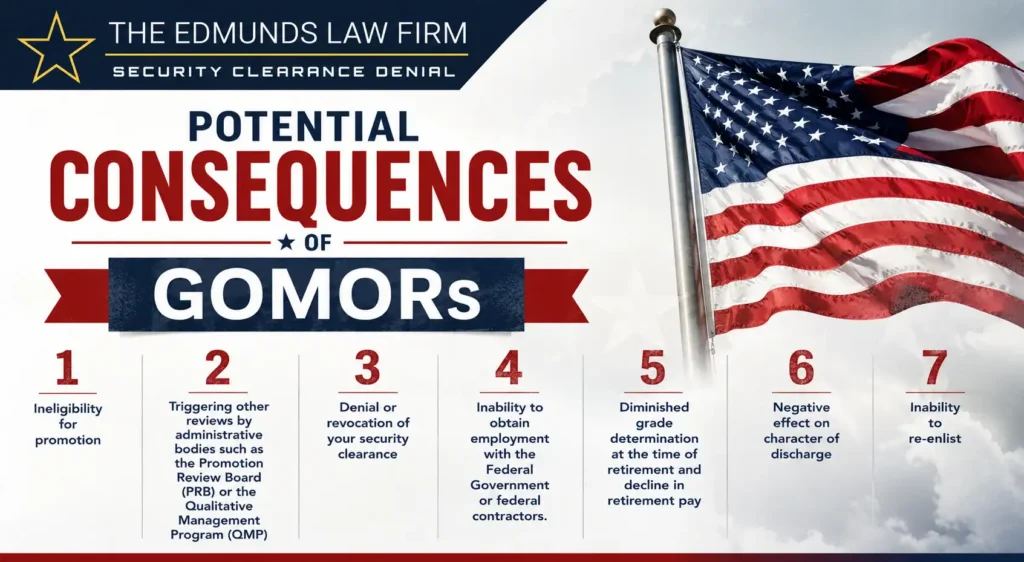
Potential consequences of a GOMOR include:
- Ineligibility for promotion
- Triggering other reviews by administrative bodies such as the Promotion Review Board (PRB) or the Qualitative Management Program (QMP)
- Denial or revocation of your security clearance
- Inability to obtain employment with the Federal Government or federal contractors
- Diminished grade determination at the time of retirement and decline in retirement pay
- Negative effect on character of discharge
- Inability to re-enlist
If a GOMOR or other service-related action has impacted your discharge or military record, consulting a lawyer for military discharge upgrades can be a critical step in protecting your career and securing the benefits you’ve earned.
To avoid these consequences among many others, it’s imperative that an OMPF is corrected.
WHAT TO DO IF A GOMOR IS FILED AGAINST YOU
Stop everything and seek immediate help from a legal professional experienced in military matters. Due to minimal due process rights, you are presumed guilty unless you can prove innocence. GOMORs are extremely fact specific, and so their rebuttals must be as well. You are not required to rebut a GOMOR filing but neglecting to do so can be a career death sentence.
You may have already received some terrible advice: to just accept responsibility and ask for it to be locally filed. That may be the easier route for the moment, but it holds dire consequences in the future. Admitting guilt at this stage can (and likely will) be used against you in a subsequent administrative or criminal proceeding such as a court-martial, chapter board, or Article 15 punishment.
All recipients of GOMOR actions have two important due process rights. First, they must be given an opportunity to review the documentation that serves as the basis for the proposed filing. Otherwise, there’s no meaningful way to defend against the allegations indicated. Second, recipients must be given a reasonable amount of time to respond.
Active-duty personnel are usually given seven calendar days to respond, while Army National Guard and Reserve soldiers typically have 30 calendar days. Extensions can be granted for good reason, but they are not guaranteed and should certainly not be expected.
The rebuttal time crunch and numerous consequences riding on your rebuttal are exactly why legal representation in these cases are crucial. One wrong move, and you can lose your livelihood and future options. Although GOMORs are serious, help is but one call away.
The Edmunds Law Firm has successfully defended GOMOR charges, allowing clients to keep their well-earned jobs. Attorney Alan Edmunds and his team of top National Security lawyers are known for their advocacy and experience. With over 40 years of experience, this Firm will zealously advocate for you and your career.
IT’S YOUR FUTURE, YOUR CAREER AND YOUR REPUTATION.
Don’t wait in retaining help. Every minute counts. The moment you are informed of a GOMOR filed against you, call the Edmunds Law Firm immediately at 800.481.2526.
The Edmunds Law Firm has been representing clients throughout the United States for nearly 50 years. In many cases we have received national recognition. Mr. Edmunds has been featured in numerous newspapers throughout the United States and appeared on national TV relative to his representation.

Frequently Asked Questions About GOMOR Defense Against Army Punishment
The success rate for removing a GOMOR from a military record is generally low, but a strong rebuttal or appeal can still make a meaningful difference. Many unsuccessful general officer memorandum of reprimand rebuttals fail because the service member does not address the allegations clearly, does not provide enough supporting evidence, or does not understand what the command or review board needs to see.
A GOMOR rebuttal should do more than say the allegations are unfair. Depending on the facts, it may need to explain what happened, correct inaccurate information, provide witness statements, document your military record, show mitigating circumstances, and explain why permanent filing would be too harsh.
An experienced GOMOR rebuttal attorney can help you prepare the strongest possible response before your deadline passes. The Edmunds Law Firm will also give you an honest assessment of your chances so you can make an informed decision about how to move forward.
A GOMOR is very serious because it can affect your military career, reputation, promotion opportunities, security clearance, and future discharge status. Even though a GOMOR is administrative rather than a court-martial conviction, it can still create long-term career consequences.
A GOMOR army action may be filed locally, in the permanent portion of your Army Military Human Resource Record, or in the restricted portion of your file. The filing decision matters. A locally filed GOMOR may have a more limited impact, while a permanently filed GOMOR may follow you throughout your career and be reviewed by promotion boards or other decision-makers.
A GOMOR can also lead to additional consequences, including negative evaluations, a Qualitative Management Program review, involuntary separation, loss of key assignments, or problems with your clearance. If you have received a GOMOR, you should act quickly and speak with an experienced GOMOR lawyer before submitting your rebuttal.
No, a GOMOR is not the same thing as a dishonorable discharge. A GOMOR is an administrative reprimand, while a dishonorable discharge is a punitive discharge that can only result from a general court-martial.
However, a GOMOR can still affect your discharge outcome. A GOMOR army discharge issue may arise if the reprimand contributes to administrative separation, an other than honorable discharge, or another negative characterization of service. That can affect civilian employment, reenlistment, veterans’ benefits, and future government or contractor opportunities.
The best time to fight a GOMOR is when you first receive it. At that stage, you may be able to persuade the general officer not to file it permanently, to place it in a restricted file, or to discard it. If you have already separated and your discharge status was affected by a GOMOR, you may want to speak with a military discharge upgrade lawyer about your post-service options.
Yes, you may be able to retire with a GOMOR, but it can create serious obstacles before or during the retirement process. A GOMOR does not automatically disqualify you from retirement, but it may trigger reviews or separation actions that affect your ability to reach retirement eligibility.
A permanently filed GOMOR may affect promotion, retention, assignment opportunities, and command decisions. For some soldiers, it may contribute to a Qualitative Management Program review, administrative separation, or a reduction in rank that affects retirement benefits.
If retirement is on the line, your rebuttal should address more than the immediate allegation. It should also explain your full record of service, leadership, performance, awards, deployments, evaluations, rehabilitation, and why permanent filing would be unfair or excessive. A timely GOMOR rebuttal may help protect your career and retirement interests before the damage becomes harder to undo.
Yes, a GOMOR can affect civilian life, especially if it contributes to a negative discharge, loss of security clearance, or permanent record issue. The consequences may continue after you leave the Army.
A GOMOR may affect civilian life by contributing to:
- Loss of promotion or career advancement before separation
- Involuntary separation from the Army
- A negative discharge characterization
- Loss of or reduction in retirement benefits
- Security clearance revocation or clearance eligibility concerns
- Disqualification from certain federal or contractor jobs
- Difficulty obtaining veterans’ benefits
- Problems explaining your service record to civilian employers
Some issues may be addressed later. For example, if your discharge characterization affects your benefits or employment opportunities, you may be able to seek a discharge upgrade. If your discharge status creates problems with VA disability benefits, you may also have options to pursue benefits or correct your record.
Still, the best protection is early action. Fighting the GOMOR before it is permanently filed may give you the strongest chance to protect your record, clearance, benefits, and civilian future.
You usually have a short deadline to submit a GOMOR rebuttal, often around 7 to 10 days from the date you receive it. Your notice should tell you the exact suspense date, and you should not assume you will receive extra time.
Because the response window is short, you should start gathering evidence immediately. Useful evidence may include witness statements, text messages, emails, counseling records, evaluations, awards, deployment history, medical records, proof of rehabilitation, character letters, and documents that correct or explain the allegations.
If you need more time, you may be able to request an extension, but it is not guaranteed. Speak with a GOMOR lawyer as soon as possible so your response is focused, supported, and submitted before the deadline.
Yes, you may be able to pursue a GOMOR appeal after it is filed, but the process depends on where the GOMOR was filed and what relief you are seeking. A locally filed reprimand may be handled differently from a GOMOR placed in the AMHRR.
If the GOMOR was filed in your AMHRR, you may be able to request removal or transfer to the restricted file through the appropriate Army review process. These requests usually require strong evidence showing that the GOMOR is untrue, unjust, improperly filed, or no longer serves its intended purpose.
A GOMOR appeal is different from the initial rebuttal. The initial rebuttal asks the command not to file the reprimand permanently in the first place. A later appeal asks a review authority to remove, correct, or transfer a reprimand that has already been filed. Both stages require careful evidence and a clear legal strategy.
A strong GOMOR rebuttal should directly address the allegations, provide supporting evidence, and explain why the reprimand should be withdrawn, locally filed, or placed in a restricted file instead of permanently filed. The goal is to give the general officer a clear reason not to take the most damaging action.
Depending on the facts, your rebuttal may include:
- A direct response to each allegation
- Evidence showing the allegation is false, exaggerated, or missing key context
- Witness statements from people with firsthand knowledge
- Favorable evaluations, awards, and deployment history
- Character letters from leaders, peers, and subordinates
- Evidence of rehabilitation, treatment, counseling, or corrective action
- Proof that the incident was isolated or unlikely to happen again
- A clear explanation of how permanent filing would unfairly damage your career
A rushed or emotional response can hurt your case. Your rebuttal should be factual, organized, and focused on the specific outcome you want. If you received a GOMOR, contact The Edmunds Law Firm before your deadline passes so your response can be prepared with the care your career deserves.

Facing a Security Clearance Issue?
Free, confidential consultation with an attorney who does this every day. Nationwide representation, open 24/7.