


Security Clearance Lawyers for Alcohol Issues



REQUEST FREE CONSULTATION
Nationwide Representation. Open 24/7. Contact Anytime.
Alcohol & Drugs in Security Clearance
#1 Nationally-Ranked Security Clearance Lawyers Serving Nationwide Since 1976
Evidence of prior drug/alcohol use in your background or a positive drug test could lead you to experience difficulties during your security clearance application process. With the right legal help, however, it is possible to successfully obtain or keep a security clearance. The key is effective legal counsel on your side. Our nationwide security clearance attorneys at The Edmunds Law Firm can walk you through this process and help you navigate the requirements and roadblocks.
Defending clearance holders, contractors, and applicants since 1976.
Security clearance, DOHA, discharge, and debarment cases nationwide.
Personally argued by Alan Edmunds before DOHA and federal review boards.
Security Clearance Granted After Drug Use – Real Case Win by Attorney Alan Edmunds

Video Summary
Key Takeaways
- Applicant Profile: A 24-year-old single systems engineer and federal contractor applying for his very first security clearance.
- The Obstacle: The applicant had a documented history of drug use dating back to high school, which included varying frequencies of cocaine, mushrooms, ketamine, and marijuana.
- Initial Rejections: Other lawyers had previously turned the client down, stating he didn’t stand a chance at securing a clearance.
- Legal Action: Alan Edmunds personally litigated the case, prepared the client for cross-examination, and submitted a comprehensive booklet of approximately 15 exhibits during the hearing.
- The Verdict: The judge ruled in the applicant’s favor on all allegations (Guideline H for drug involvement and Guideline J for criminal conduct), concluding that granting the clearance was consistent with national security interests.
Drug Use
- Some potentially disqualifying actions related to drug use include:
- Contact with / use of any drugs or other controlled substances named in the Controlled Substance Act of 1970
- History of drug abuse
- Positive drug test
- Convictions of drug offenses on your record such as sale, cultivation, manufacture, possession, or distribution
- Failure to finish a substance abuse treatment program
- Expression of intent to continue drug use
Your security clearance may be denied since drug use could be evidence of untrustworthiness. Alcoholism and other substance abuse issues can lead to poor judgment and self-control, which would disqualify an applicant from security clearance. Security clearance is the privilege of having access to sensitive information and matters affecting national security.
Alcohol Use & Your Security Clearance

Alcohol Use & Security Clearance
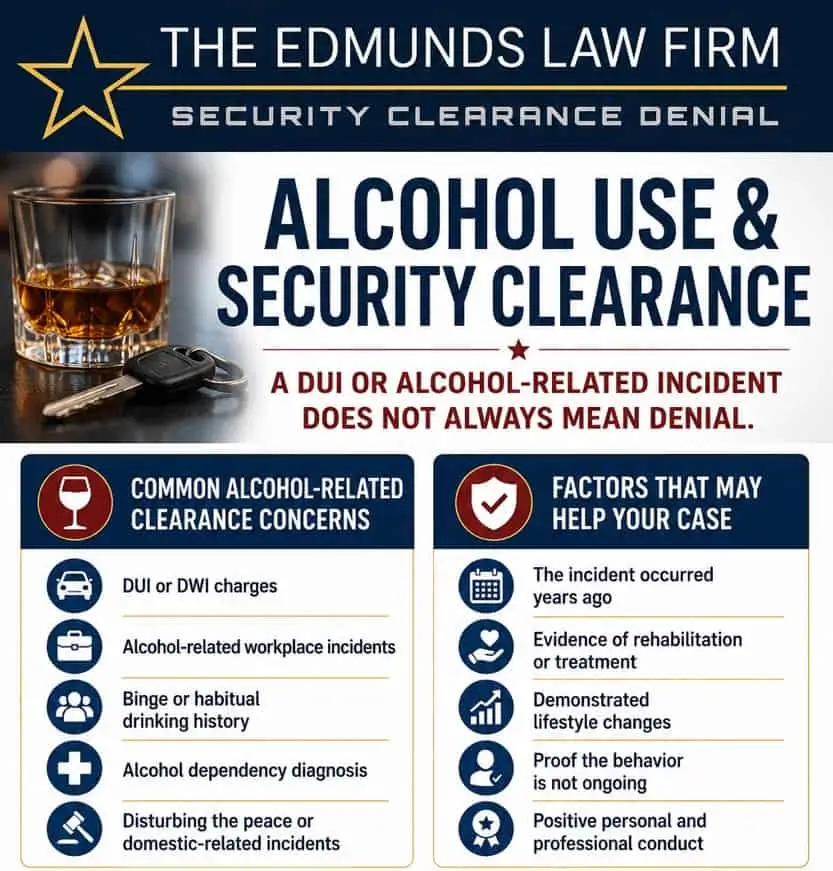
- While alcohol is legal, evidence of alcoholism can still be disqualifying; for example:
- Driving under the influence (DUI)
- Any incidents related to alcohol at work
- History/reputation of binge drinking or habitual drinking
- Diagnosis from a qualified medical expert of alcohol dependency/abuse
- Arrests or incidents such as child abuse, spouse abuse, or disturbing the peace
A DUI on your record could be disqualifying. Various factors could lessen your likelihood of a security clearance denial related to your DUI, including:
- If the incident occurred a long time ago
- If you can demonstrate that the behavior that led to the DUI is not an accurate representation of your current patterns of behavior
- If you have since taken steps to move past any substance abuse issues
“Good morning,
I just want to thank you all for assisting me with my Security Clearance issues. I will highly recommend you to anyone who runs into problems with their security clearance. I appreciate so much what you’ve done!
Stay Well”
Speak with a Nationally Top-Ranked Attorney from The Edmunds Law Firm
Completing a treatment program, attending rehabilitation, or otherwise evidencing intent and effort to overcome any alcohol-related problems could make a difference in your case. You have the right to file an appeal if you were denied security clearance for any reason. It is not uncommon for applications to be denied, especially the first time.
Denials related to alcohol/drug use can be challenging. Our team utilizes thorough preparation, evidence submission, testimonies, and more. Our security clearance attorneys have an incredible success rate in both initial applications and appeals. We know how to do the work to ensure that your application is as strong as possible and your case for clearance is presented accurately. We encourage you to speak with our attorney for security clearance about your options as soon as possible. The Edmunds Law Firm is proud to represent clients across the country.
Call The Edmunds Law Firm now at (800) 481-2526 for a consultation with our nationally ranked security clearance lawyer today.

Security Clearance Guideline G With Alan Edmunds
Frequently Asked Questions About Alcohol and Drugs and Security Clearance
Any illegal drug use can potentially create problems for a security clearance, including marijuana use. Drug involvement may affect a new security clearance application or put an existing clearance at risk, even if the use happened years ago.
Drug-related concerns may include:
- Marijuana or other illegal drug use
- Misuse of prescription medication
- Positive drug tests
- Drug possession, sale, distribution, or manufacturing charges
- A history of substance abuse
- Failure to complete a recommended treatment program
- Stated intent to continue using drugs
That does not mean every past drug issue will automatically result in denial. In many cases, concerns involving drugs and security clearance can be mitigated with the right evidence, preparation, and explanation. The government may consider how long ago the use occurred, whether it was isolated or part of a pattern, whether you have stopped using drugs, and whether your current conduct shows reliability and good judgment.
If you have a history of drug use and are seeking clearance, or if you received a Statement of Reasons citing drug use, speak with an experienced security clearance lawyer as soon as possible.
Yes, you can drink alcohol while holding or applying for a security clearance. Alcohol use by itself is not usually the issue. The concern is whether alcohol use has led to poor judgment, criminal conduct, unreliability, safety issues, or other behavior that may raise national security concerns.
For example, security clearance alcohol issues may arise from:
- DUI or DWI arrests
- Alcohol-related criminal conduct
- Drinking at work
- Reporting to work under the influence
- Repeated binge drinking or habitual intoxication
- A diagnosis of alcohol abuse or alcohol dependence
- Failure to follow treatment recommendations
The government typically will not be concerned about responsible, moderate alcohol use. But if alcohol has caused legal, employment, financial, or personal conduct problems, you may need to show that the issue was isolated, happened long ago, or has been addressed through meaningful life changes.
If alcohol may be an issue in your case, it is best to speak with an experienced security clearance attorney before submitting your SF-86. If you have already received a notice or SOR, legal help may still make a difference.
Yes, a DUI can affect your security clearance because it may raise concerns about alcohol use, criminal conduct, judgment, and reliability. A DUI does not automatically mean your clearance will be denied, but it should be taken seriously.
A DUI can create security clearance concerns because it may suggest:
- Poor judgment while under the influence
- Irresponsible alcohol use
- Criminal conduct
- A pattern of alcohol-related behavior
- Failure to follow rules or legal obligations
A single DUI from many years ago may be easier to mitigate than a recent DUI or multiple alcohol-related incidents. The facts matter. The government may consider when the DUI happened, whether anyone was harmed, whether there are other alcohol-related issues, whether you completed required programs, and whether your current conduct shows the problem has been resolved.
If you are applying for clearance with a DUI in your background, talk to a DUI security clearance lawyer before completing your SF-86. If you already received an SOR, you may have limited time to respond, so you should act quickly.
Yes, you must disclose a DUI on the SF-86 if the form requires it. A DUI can often be explained or mitigated, but failing to disclose it can create a much more serious security clearance problem.
A DUI may reflect a past mistake. Failure to disclose a DUI may suggest dishonesty, lack of candor, or an attempt to conceal information from the government. Those concerns can be harder to overcome than the underlying DUI itself.
Disclosure is not optional, but how you disclose the issue matters. You may need to provide context, explain what happened, show what has changed, and document any steps you have taken since the incident.
If you have a DUI, drug-related issue, alcohol-related incident, or other criminal history, speak with a national security clearance lawyer before completing your SF-86. If you already submitted the form and received a notice of intent to deny or Statement of Reasons, you may still be able to respond with the help of an experienced attorney.
Past drug use can prevent you from getting a security clearance, but it does not always result in denial. The outcome depends on the type of drug use, how often it occurred, how long ago it happened, whether you stopped using drugs, and whether there is evidence that the conduct is unlikely to happen again.
The government may look at several factors, including:
- The type of drugs involved
- The frequency and recency of use
- Whether drug use continued after applying for clearance
- Whether drug use continued after being warned or counseled
- Whether there was a positive drug test
- Whether there were related criminal charges
- Whether treatment, counseling, or other corrective steps were taken
Security clearance drugs cases are highly fact-specific. A well-prepared response may show that the conduct is no longer part of your life, that enough time has passed, and that you can be trusted with classified or sensitive information.
If past drug use is likely to appear in your background investigation, it is better to address it before it becomes a denial issue.
If you receive a Statement of Reasons for alcohol or drug use, you should act quickly and speak with a security clearance attorney before submitting your response. The deadline to respond may be short, and the quality of your response can affect whether your clearance is granted, denied, or moved to a hearing.
A strong response may include:
- A direct response to each allegation
- Evidence that the conduct was isolated or unlikely to recur
- Treatment or counseling records, if applicable
- Proof of sobriety or discontinued drug use, when relevant
- Character references
- Employment records
- Documentation showing rehabilitation, responsibility, and changed behavior
You may also need help deciding whether to submit a written response, request a security clearance hearing, or prepare for security clearance appeals if your clearance has already been denied.
Alcohol and drugs and security clearance concerns can be serious, but they may be mitigated with the right strategy and evidence.

Facing a Security Clearance Issue?
Free, confidential consultation with an attorney who does this every day. Nationwide representation, open 24/7.