


Polygraph Prep for Security Clearance



National Security Clearance Attorneys Serving Clients Since 1976
A polygraph exam or lie detector test relies on physiologic changes in your body to determine your truthfulness when you are asked a series of questions. These changes can be changes in your heart rate, breathing, blood pressure, and skin conductivity. Skin conductivity, which measures electrical flow from one point to another, in the polygraph test is based on moisture in the skin.
Before taking your polygraph examination as part of your application, it is best to speak with a national security clearance lawyer who has experience working with clients who have taken lie detector test and are familiar with them. An attorney from The Edmunds Law Firm can help prepare you for the exam. Our top-rated security clearance attorneys understand this aspect of the security clearance process and are able to provide help.
How Does a Polygraph Test for a Security Clearance Work?
In general, an increase in your heart rate, respiration, blood pressure, and/or perspiration can indicate stress on the lie detector test. As a rule, people who lie during a polygraph exam will experience an increase in these parameters. The polygraph examiner will question you about all aspects of your present and past behavior. It is a thorough exam that usually takes between two and four hours.
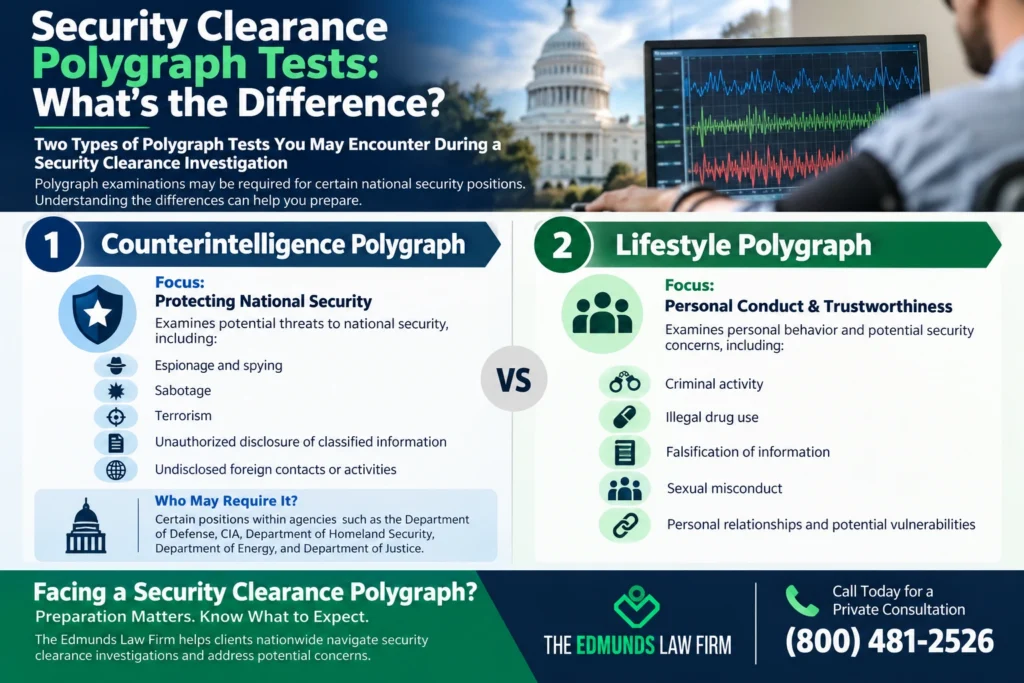
- Two types of tests may be given in a security clearance investigation:
- Counterintelligence polygraph
- Lifestyle polygraph
Counterintelligence Polygraph
- The counterintelligence polygraph for national security clearance can be conducted for numerous government agencies, including:
- The Department of Defense
- The Department of Homeland Security
- The Department of Energy
- The Department of Justice
- The Central Intelligence Agency
The counterintelligence polygraph asks questions related to spying, including the areas of espionage, sabotage, and terrorism.
Lifestyle Polygraph
The lifestyle polygraph is given to determine if a job applicant can be trusted with secret information.
- The examiner asks questions regarding:
- Criminal activity
- Use of drugs
- Purposely falsifying information on any questionnaires or during interviews
- Sexual misconduct
- Family relationships
- Mental health issues
Request a Private Consultation with The Edmunds Law Firm
Merely taking the test can be a stressful experience. Speaking with a professional who is familiar with the procedures involved and who understands why and how the test is given could help you feel more relaxed during the examination. Prior to taking the exam, applicants are told to get a good night’s sleep the night before the test, follow their normal routine, take their usual medications, be sure not to miss meals, and arrive at the test site early. If you are applying for a security clearance or contesting a security clearance denial and know you will be taking a polygraph examination, we can help you.
Contact our national security clearance law firm at (800) 481-2526 to schedule an evaluation of your case.
Taking a polygraph test can be stressful under any circumstances. When you’re asked to take a polygraph during the national security clearance application process or you already have security clearance and are called in for a polygraph, your livelihood could be on the line.
The best way to prepare for a polygraph for security clearance is to work with an experienced security clearance lawyer. At The Edmunds Law Firm, we’ve been helping people with all aspects of the national security clearance process for decades. To learn more about how we can help you with polygraph preparation and other security clearance matters, call us today.
Security Clearance Polygraphs: What You Need to Know Before You Take One

Security Clearance Polygraphs FAQs
You can lose your security clearance any time information comes to light that suggests you may be a security risk. So, if you’re asked to take a polygraph when you already have security clearance, your clearance could be at risk in two different ways. First, if you reveal something during your polygraph that confirms that there is cause for concern, you could be in danger of losing your security clearance. You could also be at risk if your polygraph test shows indications of deception–what is commonly known as “failing” a polygraph.
The amount of time it takes to get your security clearance after a polygraph depends on whether the polygraph test is the last step in the investigative stage of your process. If it is, it typically takes about two weeks for the report to be prepared, and then the process moves to adjudication. The adjudication phase may take just a few weeks or may take two to three months.
If you receive a statement of reasons that the government is planning to deny your security clearance, you’ll have an opportunity to respond. But, of course, that will add time to the process.
The questions asked during the administration of a polygraph test vary depending on your background, the level of clearance you are pursuing, your background, and other factors. A polygraph test for security clearance may be limited in scope. For example, if you already have security clearance, you may be asked to undergo a lifestyle polygraph if the agency or branch that employs you has reason to believe a new risk factor in your personal life applies. That could be suspected criminal activity, drug use, sexual misconduct, marital problems, or other areas of your personal life.
You may also be subject to a full-scope polygraph exam. This type of exam may include questions of the type you would normally be asked during a lifestyle polygraph test along with those that would be asked during a counterintelligence polygraph exam.
With nearly 50 years in the business of assisting applicants for national security clearance, the team at The Edmunds Law Firm has a solid understanding of how security clearance polygraphs are conducted, what types of questions are asked, and the factors that impact your performance on a national security polygraph.
Taking a polygraph is stressful, and that’s especially true when the stakes are high. Unfortunately, stress and uncertainty can impact the results of your polygraph. So, it’s very important to be well-prepared and relaxed when you show up for the exam. We’ll use our experience to put you at ease and ensure that you know what to expect from beginning to end.

Facing a Security Clearance Issue?
Free, confidential consultation with an attorney who does this every day. Nationwide representation, open 24/7.