

VA Disability Claims Assistance



REQUEST FREE CONSULTATION
Nationwide Representation. Open 24/7. Contact Anytime.
Attorney Alan Edmunds has been helping Veterans and Active-Duty military for over 46 years. His national practice has included VA Claims, Courts Martial, Administrative Separation Boards, Boards of Inquiry, and Military Discharge Upgrades.
Attorney Alan Edmunds is nationally recognized as an expert in this field. He has represented Veterans and Active-Duty personnel in cases around the globe. He has been a consultant for national media, including radio and television.
Contact Our Law Firm for Dedicated Counsel
Many Veterans have applied for VA Disability and have been unsuccessful. Though the process looks simple, it can, in fact, be comprehensive and difficult. This is the main reason Veterans have been turning to Attorney Alan Edmunds for over 46 years. His office of trained experts is familiar with the problems military Veterans face. Attorney Alan Edmunds has brought these issues directly to the White House and Legislature for changes.
Your VA Claims are very important to you, and they are equally important to Attorney Alan Edmunds. You will be treated in a professional and courteous manner throughout the process. While we cannot guarantee results, we can guarantee that our experience will make a difference.
Defending clearance holders, contractors, and applicants since 1976.
Security clearance, DOHA, discharge, and debarment cases nationwide.
Personally argued by Alan Edmunds before DOHA and federal review boards.
Why Veterans Choose The Edmunds Law Firm
When you’re working toward something as important as access to the VA disability benefits you’ve earned and access to the medical care you need, you want an experienced advocate at your side. At The Edmunds Law Firm, we have five decades of experience fighting for veterans and others navigating the complexities of federal government processes.
Unlike some firms, we know there is no one-size-fits-all approach to securing the benefits you deserve. When you hire a VA disability claim lawyer at The Edmunds Law Firm, you can rest assured that we will thoroughly analyze your claim or appeal and work to build the strongest possible case for you. You don’t have to take our word for it.
Call us at 800-481-2526 for a free case analysis.
How Our VA Disability Lawyers Can Help You
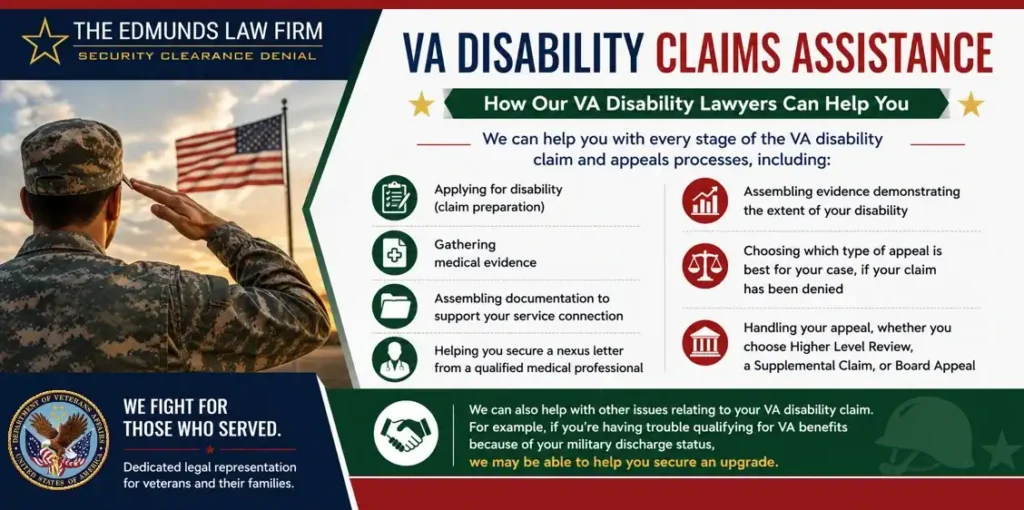
A VA disability claim attorney at The Edmunds Law Firm can help you with every stage of the VA disability claim and appeals processes, including:
- Applying for disability (claim preparation)
- Gathering medical evidence
- Assembling documentation to support your service connection
- Helping you secure a nexus letter from a qualified medical professional
- Assembling evidence demonstrating the extent of your disability
- Choosing which type of appeal is best for your case, if your claim has been denied
- Handling your appeal, whether you choose Higher Level Review, a Supplemental Claim, or Board Appeal
We can also help with other issues relating to your VA disability claim. For example, if you’re having trouble qualifying for VA benefits because of your military discharge status, we may be able to help you secure an upgrade.
How to file a VA disability claim
Find out how to file a claim for disability compensation or increased disability compensation.
How do I prepare before starting my application?
- Find out if you’re eligible for VA disability compensation
- Gather any evidence (supporting documents) you’ll submit yourself when you file your VA disability claim.
- Be sure your claim is filled out completely and you have all the supporting documents ready to send in along with your claim. This will help us process your claim quickly.
- Find out if you’ll need to turn in any additional forms with your claim
Types of VA Disability Claims
You may qualify for VA disability benefits for any disabling illness or medical condition that is service-connected. In fact, you may be able to get a VA disability rating for a secondary-connected condition–that’s a condition that isn’t directly service related, but is caused by a service-connected condition or the treatment for a service-connected condition.
Some conditions veterans receive VA disability benefits for include:
- Post-traumatic stress disorder (PTSD)
- Cancers and other conditions caused by toxic exposures such as Agent Orange or burn pits
- Hearing loss and tinnitus
- Migraine
- Limitation of motions of an arm or knee
- Sciatic nerve paralysis
- Burn scars
- Gulf war syndrome
- Military sexual trauma
An experienced VA disability claim lawyer can help ensure that you are including all conditions that may be service-connected or secondarily connected. That’s important because even a small change in your VA disability rating can make a difference in your benefits.
What evidence will I need to provide to support my claim?
You can help to support your VA disability claim by providing documents such as:
- VA medical records and hospital records that relate to your claimed illnesses or injuries or that show your rated disability has gotten worse
- Military service records documenting the incident that led to your injury or the time and place of service or duty assignment that led to the toxic exposure
- Private medical records and hospital reports that relate to your claimed illnesses or injuries or that show your disability has gotten worse
- Supporting statements you’d like to provide from family members, friends, clergy members, law enforcement personnel, or those you served with that can tell us more about your claimed condition and how and when it happened or how it got worse
Common Reasons a VA Disability Claim May Be Denied
When you file a VA disability claim, it’s up to you and your attorney to prove that you suffer from one or more medical conditions and that the condition is service-connected. You will also need to show the severity of the condition to establish your VA disability rating.
Some common reasons VA claims are denied include:
- Lack of a current diagnosis
- Insufficient medical documentation
- Insufficient evidence to establish a service connection, such as failure to provide a well-constructed nexus letter
- Failure to cooperate with evidence collection, such as not showing up for a C&P exam
- Incomplete forms or errors in completing the claim
The best way to avoid these errors or omissions is to work with an experienced VA disability claim lawyer from the beginning. But don’t worry–if you’ve already filed your claim and been denied, we can still help.
IT’S YOUR FUTURE.
Call us today at 800-481-2526 and let’s get started.

Frequently Asked Questions About VA Disability Claims
For complex claims, denied claims, or appeals, an experienced VA disability claim lawyer can be one of the best sources of help. A VA claims attorney can help identify missing evidence, strengthen the service connection argument, prepare appeal materials, and avoid mistakes that can delay or weaken your claim.
Some veterans use a Veterans Service Organization for straightforward initial claims. But if your claim involves a prior denial, unclear medical evidence, secondary conditions, PTSD, traumatic brain injury, military sexual trauma, an other than honorable discharge, or a difficult service connection issue, legal guidance may be especially valuable.
At The Edmunds Law Firm, our practice is focused on helping service members, veterans, government employees, and contractors protect the benefits, clearances, and careers they earned through service. Attorney Alan Edmunds has decades of experience helping veterans with VA disability claims and related military issues. If you are applying for VA disability or challenging a denial, an experienced VA disability claim lawyer can help you understand your options and build a stronger claim.
The hardest VA disability claims to get approved are often claims with limited medical documentation, unclear service connection, delayed symptoms, or conditions that are difficult to measure objectively. These claims require strong evidence showing both the diagnosis and the connection to military service.
Commonly difficult VA claims may involve PTSD, traumatic brain injury, chronic pain, migraines, sleep apnea, mental health conditions, toxic exposure, or secondary conditions that develop after service. These claims are not impossible, but they often require more than a diagnosis.
For example, PTSD may not appear immediately after a traumatic event, and symptoms may be documented years after service. In those cases, the veteran may need service records, medical records, lay statements, buddy statements, incident reports, treatment history, and a strong medical nexus opinion.
The key is evidence. A VA claims attorney can help you identify what is missing, organize your records, and present the clearest possible connection between your condition and your military service.
Some of the most overlooked VA disability claims are secondary conditions, mental health conditions, and disabilities veterans assume are just part of aging or normal post-service life. A condition may still qualify for benefits if it is connected to service or caused or aggravated by another service-connected condition.
Secondary service connection is commonly overlooked. This happens when one service-connected disability causes or worsens another condition. For example, a service-connected knee injury may contribute to back problems, altered gait, hip pain, or other orthopedic issues. Sleep problems, migraines, depression, anxiety, and medication side effects may also be connected to an existing service-connected condition.
Veterans also often overlook mental health claims. PTSD, anxiety, depression, and other mental health conditions may be connected to combat, training accidents, military sexual trauma, personal assault, serious injury, or other service-related experiences.
When you work with an experienced VA disability claim lawyer, your attorney can help review your medical history, service records, current symptoms, and existing ratings to determine whether you may have additional service-connected or secondary-connected claims.
Good signs that your VA claim may be approved include a current diagnosis, clear evidence of an in-service event or exposure, and strong medical evidence connecting the condition to your service. The stronger those three areas are, the better your claim is likely to be.
Positive signs may include:
- A clear diagnosis from a qualified medical provider
- Consistent medical records showing symptoms over time
- Service treatment records documenting the injury, illness, exposure, or event
- A presumptive service connection based on where, when, or how you served
- A favorable Compensation and Pension exam
- A strong nexus letter from a medical professional
- Lay statements from family members, friends, fellow service members, or supervisors
- Evidence that your condition affects work, daily life, mobility, sleep, concentration, or mental health
These are not guarantees, but they can strengthen your claim. If your evidence is thin, inconsistent, or missing a medical nexus, your attorney may recommend gathering additional records, obtaining a medical opinion, or clarifying your symptoms before filing or appealing.
A successful VA disability claim usually requires three things: a current disability, an in-service event or exposure, and a connection between the two. These are often called the diagnosis, in-service event, and nexus.
To qualify for VA benefits, you generally need:
- A current medical condition or disability
- Evidence that something happened during military service, such as an injury, illness, exposure, event, or aggravation of a pre-existing condition
- Medical or other persuasive evidence connecting your current condition to your service
Some conditions are presumptively service-connected. That means the VA may presume the connection based on your service location, time period, exposure, or diagnosis, so you may not have to prove the nexus in the same way.
Your discharge status also matters. Veterans with honorable or general discharges often meet the discharge requirement if they are otherwise eligible. Other discharge statuses can make qualifying for VA benefits more complicated. If your discharge status is creating problems, you may need help from a military discharge upgrade lawyer.
Yes, some veterans with an other than honorable discharge may still qualify for VA disability benefits, but the process is more complicated. The VA may conduct a character of discharge review to decide whether your service qualifies for benefits.
An other than honorable discharge does not always automatically bar a veteran from receiving VA disability compensation. The VA will look at the facts surrounding the discharge, the period of service, and whether any statutory or regulatory bars apply.
If your discharge status is preventing you from qualifying for VA benefits, you may have options. You may be able to pursue a VA character of discharge determination, request a discharge upgrade, or seek correction of military records. The best path depends on your service history and the reason for the discharge.
The Edmunds Law Firm assists veterans with both VA disability claims and military discharge issues. If your benefits were denied because of your discharge status, our team can help you evaluate whether a military discharge upgrade may improve your position.
Yes, you can appeal a denied VA disability claim. A denial does not always mean your claim is weak. It may mean the VA did not have enough evidence, missed key records, assigned the wrong rating, rejected the service connection, or relied on an unfavorable exam.
Depending on the situation, you may be able to request a Higher-Level Review, file a Supplemental Claim with new and relevant evidence, or appeal to the Board of Veterans’ Appeals. The right option depends on why the claim was denied and what evidence is available.
A VA claims attorney can review the decision letter, identify the reason for the denial, and help determine the strongest appeal strategy. In many cases, the most important step is adding the evidence the VA said was missing, such as medical records, a nexus opinion, lay statements, or proof of worsening symptoms.
If your VA disability claim was denied, do not assume the decision is final. Speak with an experienced attorney before your appeal deadline passes.
A VA disability claim lawyer can help you understand why your claim was denied, identify missing evidence, develop a stronger service connection argument, and guide you through the appeal process. For many veterans, the biggest challenge is not whether they have a valid disability, but whether the claim is documented in the way the VA requires.
A lawyer may help by:
- Reviewing your VA decision letter
- Identifying errors in the denial or rating decision
- Gathering medical and service records
- Helping develop lay statements or buddy statements
- Identifying secondary conditions
- Requesting or reviewing medical nexus evidence
- Preparing appeal materials
- Challenging an unfair disability rating
- Addressing discharge-related eligibility issues
- Representing you through the VA appeals process
The Edmunds Law Firm helps veterans pursue the benefits they earned through military service. If you are applying for VA disability, appealing a denial, or trying to qualify for VA benefits after a discharge issue, contact the firm to discuss your options.

Facing a Security Clearance Issue?
Free, confidential consultation with an attorney who does this every day. Nationwide representation, open 24/7.